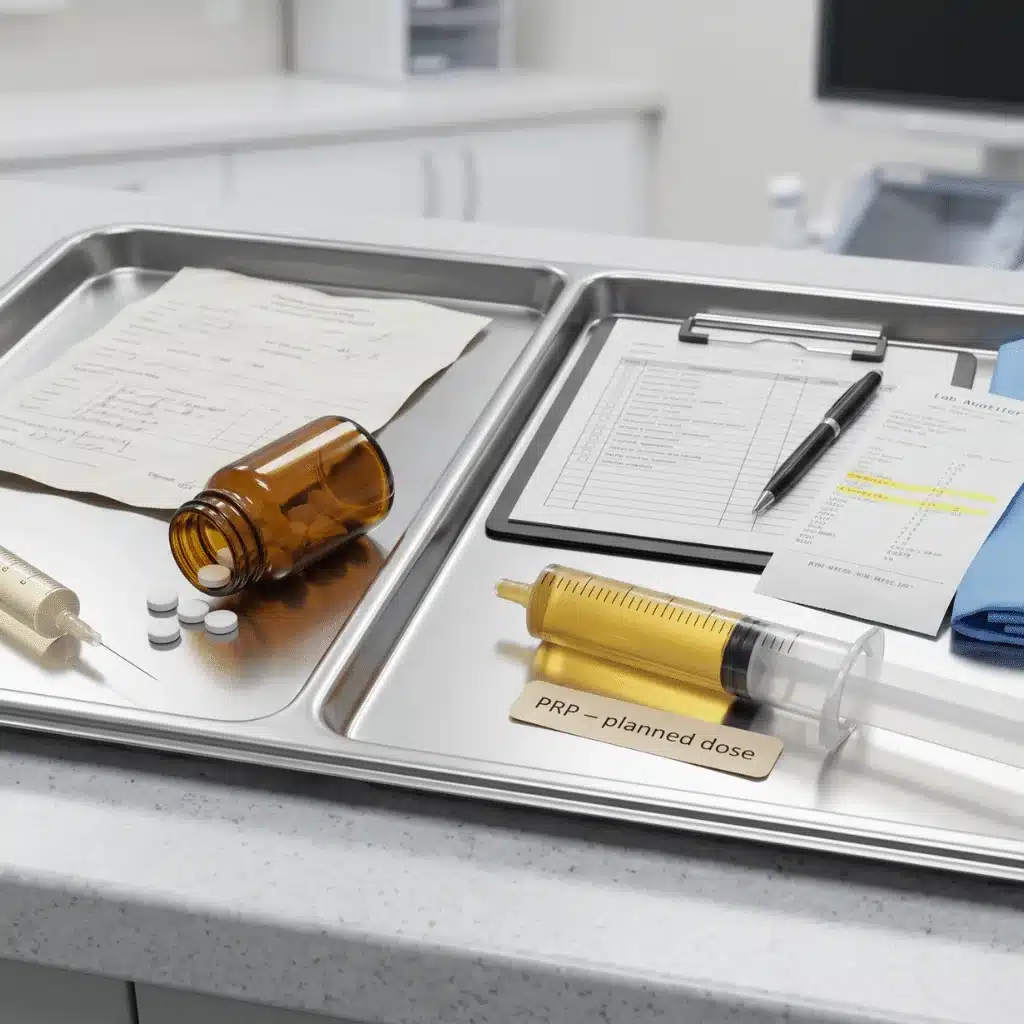
Platelet-rich plasma (PRP) is not one standard product, and published trials of PRP injections report mixed results. Some of what changes from one clinic to the next is in the clinic’s own hands: how the PRP is prepared, how much is given, where the needle goes, who is screened out, and which medications are paused. This guide walks through five common, preventable problems in that workflow and what training covers for each.
Summary: This post groups common, preventable PRP workflow problems into five: a dose nobody planned or recorded, landmark-only injection, missed contraindications, unmanaged medication holds, and preparation choices made without a reason, including activation. PRP preparation devices are FDA cleared for use with bone graft material. Injecting PRP into joints, tendons, ligaments, skin or scalp is off-label. The evidence is mixed, and the 2026 ACR guideline update strongly recommends against PRP for knee and hip osteoarthritis. Training gives you supervised cases and a method. It does not guarantee a clinical result.
Published trials do not agree on what PRP injections do, and they did not all use the same PRP. Preparation, platelet concentration, leukocyte content, injection technique, and patient groups differ from trial to trial, which makes the results hard to compare. The same variables are the ones a clinic controls in its own workflow, and they are where the preventable problems in this post happen.
Each section below names the problem, what the published evidence does and does not say, and what training covers. The goal is a workflow you can repeat and record, with informed consent that says plainly what is known and what is not.
Important Disclaimer
Regenerative Medicine Academy (RMA) is an education company providing training for licensed clinicians. This article is educational content and does not constitute medical advice, legal counsel, or any guarantee of clinical outcomes. Techniques discussed may be used off-label and are subject to state and federal regulations. Clinicians are responsible for understanding FDA status, scope of practice, informed consent, and malpractice implications before using any technique in practice. Individual clinical judgment and patient-specific factors must guide all clinical decisions.
Why PRP results are hard to compare between clinics
One reason PRP results are hard to compare is that PRP is not one product. It is a family of autologous (patient-derived) blood preparations that differ in platelet dose, white blood cell content, activation method, and injection technique. When any of those variables differ, two patients did not receive the same thing.
A widely cited review of commercial PRP systems found that final platelet concentration can range from about half of baseline whole blood to nearly ten times baseline, depending on the device and draw volume. Similar variability shows up in white blood cell content, injection volume, and growth factor profile. Two clinics both using “PRP” can deliver very different biologics.
Injection accuracy, patient screening, and medication use also differ from one clinic to the next. Each is a step in the workflow that a clinic controls, and each can be taught, checked, and recorded.
What this means in practice: Before you change kits, check whether your workflow plans and records dose, guidance, screening, and medication instructions the same way for every patient. Without that record, no single case can tell you much.
What PRP is, briefly
PRP is a concentrate of platelets made from a patient’s own blood. PRP contains growth factors from platelets and from the plasma. Growth factors are signaling proteins.
Laboratory and animal studies of these proteins do not show what happens in a patient. Whether a PRP injection into a joint, tendon, scalp, or skin has a clinical effect is the question clinical trials are testing, and their results are mixed. Each of those injection uses is off-label.
Platelet dose is one factor researchers study. In knee osteoarthritis, a 2025 meta-analysis discussed in the dose section below reports an association across trials between higher platelet concentration and greater pain relief compared with placebo. No society names a minimum or a target dose. That is why the first problem on this list is a dose that nobody planned or recorded.
Free mini course
The FDA rules behind this field, in a short, self-paced course. It costs nothing.
Get the free FDA courseThe regulatory context every PRP clinician should know
PRP preparation systems are cleared under the FDA 510(k) pathway as Class II medical devices for use with bone graft material. FDA’s product classification for these devices (product code ORG) gives this definition: “Preparation of autologous platelet rich plasma from a small sample of peripheral blood for mixing with bone graft to improve handling characteristics.” That clearance does not approve or clear PRP for any injection use in patients.
Injecting PRP into joints, tendons, ligaments, skin or scalp is off-label. That includes knee osteoarthritis (OA), tendinopathy, hair loss, aesthetic uses, and sexual health uses. Under 21 U.S.C. 396, nothing in the federal drug and device law shall be construed to “limit or interfere with the authority of a health care practitioner to prescribe or administer any legally marketed device to a patient” within a legitimate practitioner-patient relationship. The same section does not change the existing limits on promoting unapproved uses, so marketing must not state or imply FDA approval for these uses. Whether you may perform the procedure is a question for your state license and board.
Clinicians should document off-label status clearly in informed consent, avoid cure or guarantee claims, and say plainly that the evidence is mixed and that results vary. Marketing and consent wording carry their own regulatory risk, separate from technique, and training should cover both.
Mistake 1: Not planning or recording the platelet dose
The first problem is running a kit without knowing what dose it delivers. Platelet dose is studied as one factor in PRP research, and no society names a minimum or a target dose. A clinic that does not plan and record the dose cannot compare its own cases or explain its preparation to a patient.
Commercial kits vary widely. The review of commercial systems cited above reports that “PRP final product concentrations as well as PRP preparation protocols varied widely between systems,” so two “PRP” injections can deliver very different actual doses. A 2025 meta-analysis of randomized trials by Bensa and colleagues in the American Journal of Sports Medicine split knee osteoarthritis trials by platelet concentration. It reported that the higher-concentration group “provided clinically significant pain relief,” while the lower-concentration group did not show a clinically perceivable benefit on pain scores. That is an association across groups of trials. It is not a dose target, and it does not show that dose causes a result.
One randomized trial in knee OA, the 2021 RESTORE study published in JAMA, found that leukocyte-poor PRP “did not result in a significant difference in symptoms or joint structure at 12 months” compared with a saline placebo. The 2026 ACR guideline update, a summary approved by the ACR Board of Directors on September 8, 2026 ahead of the full papers, says: “In people with knee and hip OA, we strongly recommend against PRP treatment.” Injecting PRP into the knee is off-label, and the evidence is not settled in its favor. A dose plan records what you gave. It does not predict what a patient will feel.
Dose also shifts from patient to patient. A kit concentrates what is in the patient’s own blood, so the same kit run on two patients with different starting platelet counts can produce two different doses. That is one reason a baseline blood count belongs in the dose plan.
What this means in practice: Clinicians should think in terms of total platelets delivered (volume multiplied by concentration), not a kit name. Training should cover how to interpret a baseline complete blood count (CBC), adjust draw size within safe limits, select spin protocols thoughtfully, and verify yields where possible.
Mistake 2: Landmark-only (blind) injections without imaging guidance
The second problem is relying on surface anatomy alone for a target where image guidance is available. If the needle does not reach the intended tissue, the PRP went somewhere else, and the case tells you nothing about the plan.
A 2024 umbrella review by Shen and colleagues pooled 17 systematic reviews and meta-analyses of injections for musculoskeletal pain. Its abstract reads: “Generally, ultrasound-guided injections were found to be more accurate than landmark-guided injections,” and its discussion says that for the shoulder, ultrasound guidance “generally yields higher accuracy rates.” Results for pain relief and function varied, and the authors rated 13 of the 17 included reviews low or critically low in quality.
For tendons, a plan may name a specific placement: around the tendon, within it (fenestration), or at a specific region such as the common extensor origin in lateral epicondylitis. Those placements are done while watching the needle on ultrasound, so they belong in the imaging part of training.
Clinicians who inject PRP should become comfortable using diagnostic ultrasound for the targets they treat most often. That skill set includes scanning, needle tracking (in-plane and out-of-plane), and matching approach to pathology. Training should include supervised, hands-on ultrasound practice, not just didactic instruction.
Mistake 3: Poor patient selection and missed contraindications
The third mistake is offering PRP to patients who should not receive it. Missed contraindications add risk and create informed consent problems. PRP has absolute and relative contraindications that clinicians should screen for systematically.
Before discussing candidate criteria, two terms are worth defining. Platelet disorders are conditions where platelets are too few or do not work properly. Anticoagulants are medications that reduce blood clotting.
The 2025 consensus of the International Research Group on Platelet Injections (GRIIP) sets out recommendations across infectious, oncologic and hematologic conditions. PRP is not injected near benign or malignant tumors, in solid or hematologic cancer under diagnosis or active treatment, during a bacterial infection that still needs antibiotics, or until a dental infection or invasive oral procedure has resolved. Chronic viral infection, dialysis, stable immunosuppression, investigated thrombocytopenia and cancers in remission are handled case by case, several only with the treating specialist’s agreement. Anticoagulant and antiplatelet interactions, and comorbidities outside those three groups, sit outside the GRIIP scope and belong to your own intake protocol.
The table below summarizes the three categories the GRIIP consensus covers, adapted from that document, and the reasoning behind them.
| Category | Example contraindications | Clinical reasoning |
|---|---|---|
| Hematologic | Unexplained blood count abnormality (investigate before injecting); hematologic malignancy under diagnosis or not yet stabilized | Unreliable platelet yield. GRIIP asks that a significant blood count abnormality be investigated before injection, and notes that previously investigated thrombocytopenia above 50,000 per cubic millimeter, excluding hematologic malignancy, is not by itself a contraindication |
| Oncologic | Active solid cancer under diagnosis or treatment; injection in the vicinity of benign or malignant tumors or metaplasia | Theoretical concern about growth factor signaling near tumor tissue; cancers in remission are reviewed with the oncologist |
| Infectious | Bacterial infection still requiring antibiotics; dental infection or recent invasive oral procedure; local infection at the site; detectable viral load in HIV or hepatitis B; untreated hepatitis C | Risk of seeding or spreading infection; dialysis patients need monitoring and no injection on a dialysis day |
A checklist-driven intake process that includes a CBC review, medication reconciliation, oncology screening, and site examination is how a clinic finds these problems before the needle is drawn. Training should cover structured intake templates, documentation habits, and informed consent language that clearly states off-label status and patient-specific risks.
Mistake 4: NSAID mismanagement before and after PRP
The fourth problem is not asking about non-steroidal anti-inflammatory drugs (NSAIDs), aspirin, other antiplatelet drugs, and anticoagulants before a PRP injection, and not recording what was decided.
There is no agreed washout period. Published protocols differ, so follow your own protocol and the prescriber, and never stop an antiplatelet drug without the prescriber.
Aspirin and other antiplatelet drugs are a question for the prescriber, often the cardiologist. Record what the patient takes, what was decided, who decided it, and how cardiovascular and bleeding risk were weighed.
A pre-procedure medication checklist and a standard post-procedure handout keep the plan the same for every patient. Training should cover patient education scripts, how to coordinate with the prescriber on anticoagulant and antiplatelet drugs, and how to document shared decisions in the chart.
Mistake 5: Inconsistent preparation, the leukocyte debate, and activation
The fifth mistake is treating all PRP as the same PRP, and applying assumptions that the published literature does not actually support. Preparation method, leukocyte content, and activation approach all shape the final biologic. Choosing them by convenience or by habit leaves no record of why, and makes one case hard to compare with the next.
Preparation variability is well documented. Across commercial systems, final platelet concentration ranges from below baseline to many times it, with very different volumes and white blood cell profiles. Even the same kit can yield different products depending on operator technique and baseline patient values. The right framework is not “what kit do I use” but “what total platelet dose does my workflow reliably deliver, and what is actually in my final product.”
The leukocyte question: an unsettled debate built on incomplete data
The choice between leukocyte-rich PRP (LR-PRP, which retains higher white blood cell levels) and leukocyte-poor PRP (LP-PRP, which is filtered to minimize them) is one of the most discussed topics in PRP preparation. It is also one of the most poorly resolved, and not because the underlying biology is uninteresting. The honest assessment is that many of the published comparisons rest on inconsistent measurement and reporting, which makes “which is better” a question that often cannot be answered cleanly from the data we have.
A more useful starting point is a set of questions to ask of any study comparing LR-PRP and LP-PRP. These questions are how a careful clinician should read the literature, and they double as a checklist for evaluating any future device claim or comparative trial.
The first question: what was the actual measured leukocyte concentration in the product used? Many published studies label preparations as “leukocyte-rich” or “leukocyte-poor” based on the kit type, the spin protocol, or the manufacturer’s claim, without quantifying the actual leukocyte content at the time of preparation. When a study does not report measured leukocyte values, you do not actually know what was injected, and you should hold conclusions from that study loosely.
The second question: what was the patient’s baseline white blood cell count? Final leukocyte content depends on starting blood values, just as platelet content does. A so-called leukocyte-rich preparation made from a patient with a low baseline white blood cell count could deliver fewer total leukocytes than a so-called leukocyte-poor preparation made from a patient with a high baseline. Without knowing the baseline, you cannot interpret the final number.
The third question: what was the relative composition of those leukocytes? Neutrophils, lymphocytes, and monocytes have different signaling roles. A preparation dominated by neutrophils may behave biologically differently than one dominated by lymphocytes, even at the same total leukocyte count. Most published studies do not break down the leukocyte composition, which is another piece of information missing from the comparison.
The fourth question: were leukocyte content and platelet dose reported together? Leukocyte content and platelet dose are typically correlated based on preparation method, but the correlation is not perfect. A study that reports only one of these variables provides only half the information needed to interpret the result.
When the literature is read with these questions in mind, the LR-versus-LP debate looks humbler than the often-quoted “LR for tendons, LP for joints” framing suggests. Which preparation suits which use is not settled. Consensus statements and trials do not agree on one answer. The 2024 ESSKA-ORBIT consensus considers both LR-PRP and LP-PRP valid options for knee OA, with the explicit caveat that effectiveness is likely multifactorial and the dependence on leukocyte presence alone may be overestimated.
What this means in practice: Choose a preparation on purpose and record it, along with the reason. Until studies consistently report measured leukocyte content alongside platelet dose, any conclusion that one preparation is superior should be held loosely, and any device claim about leukocyte content should be checked against measured values rather than label language.
Activation: protocols differ, and the evidence is limited
Some preparation protocols include activating PRP before injection using exogenous agents such as calcium chloride, thrombin, or collagen. The original idea was that activation triggers platelet degranulation and growth factor release, ensuring the bioactive cargo is available immediately upon delivery.
Published musculoskeletal protocols differ on whether to activate PRP before injection. Some leave it unactivated, on the reasoning that it will activate at the target tissue, and some add an agent. The published comparative evidence between activated and unactivated PRP for musculoskeletal use is limited, and there is no consensus that adding an activator changes outcomes.
What this means in practice: Decide on activation on purpose, write the reason into your protocol, and record it for each case. Adding anything to PRP, including an activator, raises its own regulatory question, and it must be checked before you do it.
What training covers for each of the five
Each of the five problems is a step in the workflow that can be taught and practiced: intake screening, imaging, dose planning, delivery, medication instructions, and recording what was done.
Here is how a case review usually runs in a structured workflow: pull the chart and check the recorded dose and preparation, the medication plan, the screening, and how the needle was guided, then note what was never written down. A review like that cannot tell you whether PRP would have helped the patient. It shows whether the plan was followed and recorded.
Supervised, hands-on ultrasound practice lets you scan and guide a needle with an instructor watching. Supervised cases on consenting patients add feedback on your own technique. A structured curriculum on contraindications, informed consent, off-label framing, and the reporting problem in the published literature is designed to help you explain the procedure to patients and document it. Training gives you supervised cases and a method. It does not guarantee a clinical result.
For clinicians building or refining their skills, hands-on musculoskeletal regenerative medicine training offers supervised practice on consenting patients with an instructor’s feedback; the introductory PRP course for musculoskeletal injuries covers preparation, ultrasound-guided technique and the consent conversation on live patients. Didactic foundations, which are also essential, can be covered in regenerative medicine e-learning courses that complement in-person training. Clinicians working in aesthetic applications may also find value in cosmetic regenerative medicine training, where similar principles of dose, patient selection, and technique apply to different tissues. Broader profession-level commitment to gathering real-world data is also reflected in the AAOS Orthobiologics Registry, announced in December 2025, which is designed to track standardized composition data alongside patient outcomes at scale.
Frequently asked questions from clinicians
Is PRP FDA-approved for knee osteoarthritis, tendinopathy, or hair loss?
No. PRP preparation devices are FDA 510(k)-cleared for bone graft handling. Clinical injection uses for knee OA, tendinopathy, hair loss, and similar indications are considered off-label. Clinicians should document off-label status in informed consent and avoid language suggesting FDA approval for these uses.
How should I counsel a patient whose prior PRP injection did not work?
Start by reviewing the prior workflow. Ask about the kit, dose, imaging guidance, medication use around the injection, and post-procedure instructions. A review like that cannot tell you whether a different plan would have helped, so do not promise that a second attempt will. A candid conversation about what is known, what is uncertain, and the off-label status helps the patient make an informed decision about whether to try again.
Does ultrasound guidance really change outcomes, or only accuracy?
Accuracy is what the reviews show most clearly. The 2024 umbrella review by Shen and colleagues, linked above, found ultrasound-guided injections generally more accurate than landmark-guided ones, “though the results for pain relief and functional outcomes varied.” So the review supports a statement about accuracy more than one about pain or function. Guidance tells you where the PRP went. It does not tell you what PRP will do, and injecting PRP into a joint or tendon is off-label.
What baseline labs or screening steps are commonly recommended before PRP?
The 2025 GRIIP consensus linked above covers infectious, oncologic, and hematologic conditions, and it says “a significant abnormality in the blood count should be investigated before PRP injection.” Its authors chose not to address interactions with other treatments, so medication review, including anticoagulants, antiplatelet drugs, and NSAIDs, belongs in your own intake protocol, along with an exam of the injection site. Match the intake to your patient population and local standards.
Is LR-PRP or LP-PRP better?
That question is harder to answer than it sounds, and “which is better” may be the wrong starting point. A more useful first question is whether any given study comparing the two actually measured and reported the leukocyte content of the products used. Many published comparisons label preparations as “leukocyte-rich” or “leukocyte-poor” based on the kit or protocol, without quantifying actual leukocyte counts at the time of preparation. When measurement is missing, the comparison provides limited evidence regardless of the result. See the leukocyte section above.
Should I activate PRP before injection?
Published protocols differ, and the comparative evidence between activated and unactivated PRP for musculoskeletal use is limited, with no consensus. Some protocols leave PRP unactivated, on the reasoning that it activates at the target tissue, and others add an agent such as calcium chloride or thrombin. Adding anything to PRP raises its own regulatory question, so check it before you use it. Whatever you choose, write the reason into your protocol and record it for each case.
How much training is reasonable before offering PRP?
There is no single answer. Clinicians new to orthobiologic injections generally benefit from didactic foundations, hands-on ultrasound training, supervised procedural practice, and a period of case review. Scope of practice, state regulations, malpractice coverage, and institutional policy all play a role. Clinicians should consult legal counsel and their malpractice carrier when expanding procedural offerings.
What should a patient expect after a PRP injection?
Some soreness after the injection is common, and patients should hear that before the procedure. Do not promise a result or give a timeline for one, because results vary and none is guaranteed. Set expectations in advance, schedule a follow-up, and use a validated outcome measure where possible, so the chart records how the patient reports doing.
Key takeaways
- This post groups common, preventable PRP workflow problems into five: a dose nobody planned or recorded, landmark-only injection, missed contraindications, unmanaged medication holds, and preparation choices made without a reason.
- Platelet dose is studied as one factor, and no society names a minimum or a target dose. Plan and record total platelets delivered rather than a kit name.
- A 2024 umbrella review found ultrasound-guided injections generally more accurate than landmark-guided ones, but results for pain relief and function varied.
- A checklist-driven intake process is how a clinic screens for contraindications before the injection.
- There is no agreed NSAID washout period. Follow your own protocol and the prescriber, and never stop an antiplatelet drug without the prescriber.
- Leukocyte-rich versus leukocyte-poor PRP remains an unsettled debate. Many studies that compare the two do not measure or report actual leukocyte content, which limits how confidently any conclusion can be drawn.
- Published protocols differ on activating PRP before injection, and the comparative evidence is limited. Adding an activator or anything else to PRP raises its own regulatory question, so check it first.
- Each of these is a workflow step that training can teach. Training gives you supervised cases and a method. It does not guarantee a clinical result.
About Regenerative Medicine Academy
Regenerative Medicine Academy (RMA) is a medical education company providing hands-on, private regenerative medicine training courses for licensed healthcare professionals. RMA does not provide clinical treatments or medical services. All course content is educational and designed to support clinicians in making informed, evidence-based decisions within their scope of practice. For more information about courses and online regenerative medicine education, visit regenmedacademy.com.
Off-label use note
Procedures discussed in this article involve off-label use of FDA-cleared devices. PRP preparation devices are cleared through the FDA’s 510(k) pathway for use with bone graft material: FDA’s classification for product code ORG describes preparing PRP “for mixing with bone graft to improve handling characteristics.” Injecting PRP into joints, tendons, ligaments, skin or scalp is off-label. Under 21 U.S.C. 396, the federal drug and device law does not limit or interfere with a practitioner’s authority to prescribe or administer a legally marketed device to a patient within a legitimate practitioner-patient relationship. Clinicians must still obtain informed consent, discuss evidence, risks, and alternatives, and document thoroughly.
Platform and jurisdiction note
Scope of practice, supervision requirements, and corporate practice of medicine rules vary by state. Clinicians should consult their state medical board, malpractice carrier, and legal counsel regarding compliance in their jurisdiction before offering regenerative procedures.
For clinicians ready to strengthen their procedural skills
Clinicians ready to refine their workflows and build defensible documentation around PRP and related orthobiologic techniques can explore RMA’s full course catalog. The catalog covers musculoskeletal, cosmetic, sexual health, and adipose tissue applications, with private hands-on training at an instructor’s location and on-site delivery at your own practice for teams that want to train together with their own patients and workflow.
Or skip the catalog and talk to us.
The course that goes with this post
Introduction to PRP for Musculoskeletal Injuries
The foundation course: platelet biology, whole blood handling, spin protocols and injection technique, hands on with a supervised consenting patient.
Starting at $5,000 at an instructor’s clinic, or $10,000 inside your practice.
Important information
Education, not medical advice
Regen Med Academy provides education and training for licensed healthcare providers. Everything on this site is for educational purposes only. It is not medical advice, not a treatment recommendation, and not an offer to treat. Providers are responsible for practicing within the scope of their own license and their own state law.
Where a course can run
Courses are taught only in states where the modality is legal for the license you hold. State law in this field changes, sometimes more than once a year. Our reading of each state, with its sources and the date we checked, is on the rules by state page. It is a starting point, not legal advice. It is your responsibility to confirm the modality is legal in your state for your license. Do that before you book. The authority on your own scope is your licensing board, not us. State medical board contact details are published by the Federation of State Medical Boards.
Training on live patients
Procedures performed during training are performed on consenting patients, by licensed providers, under supervision. Participation is voluntary and outcomes vary.
Products and modalities
Some products and modalities discussed in these courses are not FDA approved or cleared for the uses described. Regen Med Academy does not manufacture, sell or endorse any product, and does not approve or clear any product. The FDA publishes guidance for patients and providers on regenerative medicine therapies.
What a certificate is, and is not
Regen Med Academy does not offer CMEs, credit hours or accreditation of any kind. What you receive is a Certificate of Completion. It records that you attended and performed the procedures under supervision. It is not a license, not a board certification, and it does not expand your scope of practice.
Coverage is yours to arrange
You are responsible for your own malpractice coverage. We will help you work out what to ask your carrier, and we recommend getting the answer in writing. Regen Med Academy does not provide, arrange or extend coverage to trainees, and nothing on this page is legal advice or an assurance of coverage.