
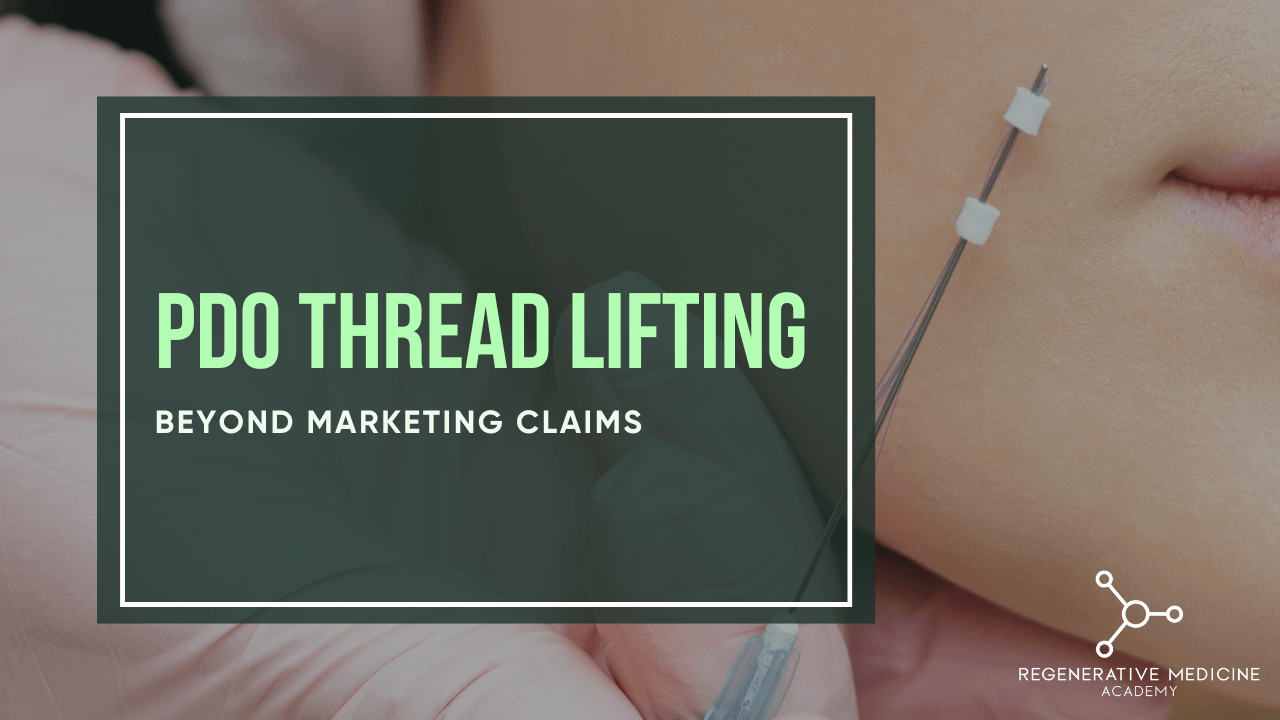
PDO (polydioxanone) thread lifting has seen a 44.7-fold increase in procedures from 2020 to 2024 across multicenter studies, reflecting growing interest in minimally invasive facial rejuvenation. This educational review examines the current evidence base for PDO threads, including mechanism of action, efficacy data, complication rates, regulatory status, and patient selection criteria. All clinical applications are off-label relative to most FDA clearances; individual results vary significantly; and no specific outcome can be guaranteed.
TLDR for Busy Clinicians
- Clinical effect duration: 6–12 months for lifting effect, depending on thread material and treatment area — not “18 months or more” as sometimes claimed
- Complication rates: Meta-analyses report swelling (33%), dimpling (12%), paresthesia (7%), thread extrusion (4%), and infection (3%); a 2025 comparative study found overall adverse effect rates under 5% for absorbable thread lifts
- FDA status: Most PDO threads are cleared only for “soft tissue approximation” — cosmetic lifting claims exceed labeled indications for most products; the FDA issued a warning letter in July 2025 to a PDO thread company for unauthorized promotion
- Thread classification: Three main categories exist (smooth/mono, screw/twist, barbed/cog) — “cog” and “barbed” are NOT separate categories
- Combination therapy: Over 60% of thread lift patients receive combination treatments; thread lift alone shows poor durability as a standalone procedure
- Patient selection: Ideal candidates have mild-to-moderate skin laxity, are generally under 50, and have realistic expectations; dissatisfaction increases with age >43 and higher thread counts
- Results vary based on individual patient factors; no outcome can be guaranteed
Clinical Scenario
A 48-year-old woman presents to your aesthetic practice inquiring about “thread lifts” she has seen promoted on social media. She has mild-to-moderate jowling and nasolabial fold deepening. She previously tried neurotoxin and filler with limited satisfaction and wants to know if threads could provide more significant lifting without surgery. She asks how long results last and what risks are involved.
This scenario reflects a common clinical encounter: a patient who has tried standard nonsurgical treatments, has seen marketing claims online, and arrives with questions about thread lifting. How do you counsel her? What does the evidence actually support? What complications should she understand? This article provides a framework for that evidence-based conversation.
Clinical Relevance: Thread Lifting in the Multimodal Era
Facial aging involves multiple tissue changes including skin laxity, volume loss, and gravitational descent of soft tissue. While surgical rhytidectomy remains the gold standard for significant tissue repositioning, many patients seek minimally invasive alternatives with shorter recovery times.
Thread lifting has evolved from a standalone procedure to a core component of multimodal facial rejuvenation strategies. Data from a 110,000-case multicenter thread lift study found that over 60% of thread lift patients received combination treatments. Hyaluronic acid filler was the most common adjunct (31.68%), followed by botulinum toxin (22.47%). This reflects clinical recognition that thread lift alone shows poor durability of effect.
Physicians should plan combination approaches (threads + fillers + neurotoxin + skin resurfacing) rather than presenting threads as a standalone solution.
Mechanism of Action: How PDO Threads Work
PDO threads exert effects through two mechanisms:
Immediate mechanical lift: Barbed threads physically reposition sagging tissue through their anchoring structure. The barbs grip subcutaneous tissue and allow repositioning toward fixation points.
Biostimulation (neocollagenesis): The foreign body response triggers fibroblast activation, TGF-β signal transduction, and production of Type I and Type III collagen. Research shows collagen formation peaks at approximately 12 weeks post-insertion and then decreases.
Material absorption timeline: PDO thread material integrity lasts approximately 24 weeks (~6 months), with complete absorption by hydrolysis in 6–8 months. Threads with greater surface area induce greater tissue response — multi-strand threads produce more inflammatory cells, myofibroblasts, and fibroblasts than mono-strand threads.
It is important to note that while these mechanisms are biologically plausible and supported by animal model data, clinical outcomes in individual patients vary significantly and cannot be predicted based on mechanism alone.
Thread Classification: What the Evidence Supports
The peer-reviewed literature recognizes three main thread categories — not six as sometimes described in marketing materials:
1. Smooth/Mono Threads
Smooth threads have no barbs and are typically inserted in a mesh pattern. Their primary use is skin rejuvenation and collagen stimulation. Smooth threads do NOT provide significant mechanical lift — they rely entirely on the biostimulatory response. Evidence level is moderate, based on multiple case series.
2. Screw/Twist Threads
Screw threads consist of one or two threads helically wound around a cannula. Their primary use is volume restoration in sunken areas such as nasolabial folds and mid-face hollowing. Evidence level is limited, based on small case series only.
Note: “Tornado threads” and “double screw threads” are commercial product descriptors referring to single-twist versus double-twist configurations — they are not distinct clinical categories recognized in peer-reviewed literature.
3. Barbed/Cog Threads
Barbed threads have projections that anchor into tissue. This category includes:
- Cog threads: Barbs created by cutting into the thread
- Molding threads: Barbs created by press-molding
Both are subtypes of barbed threads — they are NOT separate categories. Barbed threads are used for lifting and repositioning sagging tissue and have the largest evidence base among thread types.
Note: Some sources incorrectly list “cog threads” and “barbed threads” as separate categories. Cog threads ARE barbed threads (with cut barbs), and molding threads are another subtype (with molded barbs).
Thread Material Comparison: PDO vs. PLLA vs. PCL
The current evidence indicates that PDO + PCL combinations are the most common clinical approach, representing 39.18% of all procedures in large multicenter studies:
Feature | PDO | PLLA | PCL |
Degradation time | 6–8 months | 12–18 months | 18–24+ months |
Collagen stimulation | Moderate (Type I + III) | Strong (biostimulatory) | Superior (longest induction period) |
Clinical effect duration | 6–12 months | 12–18 months | 18–24 months |
Most common use | Skin tightening, rejuvenation | Volumizing alternative to fillers | Longer-lasting lift and collagen induction |
The choice of thread material affects expected duration of results. Individual outcomes vary regardless of material selection.
Current Evidence: Duration and Efficacy
Clinical Lifting Effect: 6–12 Months
Based on multicenter evidence of over 110,000 cases, clinical lifting effect typically lasts 6–12 months depending on thread material and anatomical area treated. Claims of “18 months or more” are not supported by the current evidence base for PDO threads alone.
Thread Count Does Not Guarantee Better Outcomes
A 2025 randomized clinical trial found that tissue displacement from PDO threads diminished by 60 days regardless of thread count (6 vs. 12 threads per hemiface). More threads did NOT yield better sustained outcomes.
Combination Therapy Is the Current Standard
Thread lift alone demonstrates poor durability of effect. Better results are consistently obtained in combination with fillers, neurotoxin, or skin resurfacing. The 2026 Chinese expert consensus recommends combined therapy, particularly for patients over 50.
Hybrid thread approaches combining different thread types (e.g., barbed for lifting + smooth for rejuvenation) may distribute tension more evenly and potentially extend results to 18–24 months, though this requires further study.
Complication Rates: What Physicians Must Disclose
The published literature documents meaningful complication rates that must be disclosed during informed consent.
A 2024 editorial in The Dermatologist noted that PDO thread lift complication rates exceed 30% in the published literature, underscoring that these risks should not be underappreciated.
Meta-Analysis Complication Rates (Niu et al., 2021)
A meta-analysis of thread lift complications across 26 studies documented:
Complication | Rate |
Swelling | 32.9% |
Dimpling/skin irregularity | 11.7% |
Paresthesia | 6.8% |
Thread extrusion | 3.9% |
Infection | 3.1% |
Visible/palpable threads | 1.8% |
Chinese Case Series (Li et al., 2021)
A study of 190 thread lifting complications documented:
Complication | Rate |
Contour irregularity | 16.8% |
Visible threads | 16.3% |
Infection | 8.9% |
Thread extrusion | 5.3% |
Incomplete facial paralysis | 2.6% |
More Recent Data (2025)
A 2025 comparative study in Dermatologic Surgery found that absorbable suture thread lifts exhibited complication rates under 5%, suggesting a generally favorable safety profile when using quality materials and proper technique.
The 2025 multicenter observational subset (342 patients) found dimpling at 11.7%, thread palpation at 2.3%, and transient asymmetry at 0.9%, with no serious complications reported.
Interpretation: Complication rates vary widely across studies, likely reflecting differences in thread quality, technique, patient selection, and follow-up duration. Proper training and use of cleared devices from reputable manufacturers may reduce risk. Individual outcomes cannot be predicted.
Contraindications: Who Should NOT Receive Thread Lifting
Evidence-based contraindications from the Chinese Expert Consensus (T/CAPA 009-2023, published 2026) include:
- Pregnancy and breastfeeding
- Bleeding or coagulation disorders / anticoagulant medications
- Active skin infections or inflammation in the treatment area
- Autoimmune diseases (scleroderma, sarcoidosis, etc.)
- Keloid or hypertrophic scarring tendency
- Uncontrolled diabetes
- Malignant tumors / chemotherapy / radiation
- Severe systemic diseases
- Mental health disorders (unrealistic expectations)
- Dental work within 2–4 weeks of procedure
Thread lift is not suitable for extensive skin sagging or significant facial volume loss — surgical options should be considered for these patients.
Patient Selection: Evidence-Based Criteria
Ideal Candidates
Based on published evidence, ideal candidates for thread lifting typically have:
- Mild-to-moderate skin laxity (not severe sagging)
- Age generally under 50 (though individual assessment is key)
- Realistic expectations about temporary results and limitations
- No contraindications listed above
- Previous positive experience with minimally invasive procedures
- Understanding that combination treatment may be needed
Dissatisfaction Predictors
A 2025 multicenter retrospective analysis of 1,500 PDO thread lift patients found:
- 3.4% formal dissatisfaction rate (likely underestimated due to reporting bias)
- Age >43 was a significant independent predictor of dissatisfaction
- >10 threads was a significant independent predictor of dissatisfaction
- Paradoxically, more threads were associated with MORE dissatisfaction — likely because higher thread counts correlate with more severe tissue laxity and elevated patient expectations
Clinical implication: Patients with more severe laxity who receive more threads may have higher expectations that threads cannot meet. These patients may be better served by surgical consultation or managed expectations about modest improvement.
When to Refer for Surgery
Thread lifting should NOT be positioned as equivalent to surgical rhytidectomy:
- Thread lift provides a subtle, temporary lift lasting 6–12 months
- Surgical facelift provides dramatic, long-lasting results lasting 5–10+ years
- Thread lifting does NOT reposition deeper facial structures (SMAS, muscle layer)
- Thread lifting is best positioned as a “bridge” treatment or part of a multimodal approach
Refer patients to plastic surgery consultation when they have severe skin laxity, significant volume loss, unrealistic expectations, or desire for long-lasting results.
FDA Regulatory Status: Critical Compliance Information
July 2025 FDA Warning Letter
The FDA warning letter to Les Encres LLC for unauthorized PDO thread marketing is directly relevant to clinical practice:
- The company had 510(k) clearance (K190264) for PDO threads indicated for “soft tissue approximation where use of absorbable suture is appropriate”
- The FDA cited them for promoting threads for “lift, tighten and add volume” and “cheek lift, jawline lift, neck lift, brow lift”
- The FDA stated this constitutes a major change to intended use requiring a NEW 510(k) with clinical data
- The FDA specifically noted that cosmetic use presents “additional risks such as migration, extrusion, asymmetry, visible scarring, and poor cosmetic outcomes” that require clinical evidence
- The company was ordered to cease all promotional activities making these claims
Thread FDA Clearance Status
Critical distinctions:
- Most PDO threads are FDA cleared ONLY for “soft tissue approximation” — NOT for cosmetic lifting, tightening, or rejuvenation
- MINT PDO is the only thread with three 510(k) clearances, including one specifically for “face suspension surgery to temporarily fixate the cheek sub dermis in an elevated position” (K220549, March 2023)
- PDO threads are Class II medical devices requiring 510(k) clearance — the term “FDA approved” is INCORRECT and should never be used
- Health Canada (June 2024) has authorized only ONE absorbable thread for cosmetic use and issued a public advisory about unauthorized threads
Compliance Requirements for Clinicians
Based on the FDA warning letter and regulatory guidance:
- NEVER claim threads provide a “non-surgical facelift” — this is unauthorized promotion
- NEVER use “FDA approved” — use “FDA cleared” and specify the clearance scope
- ALWAYS verify the specific 510(k) clearance of threads you use
- ALWAYS document informed consent including off-label status if applicable
- ALWAYS disclose risks, complications, and contraindications
For detailed regulatory guidance on medical devices and biologics, see the RMA guide to current FDA regulations.
Practical Considerations: Training and Documentation
Physicians adding thread lifting to their practice should ensure:
Training requirements:
- Hands-on training covering facial anatomy, danger zones, and thread insertion techniques
- Understanding of different thread types and their appropriate applications
- Competency in complication recognition and management
- Training in combination treatment planning
Training supports standardization and risk management; it does not ensure clinical outcomes.
Documentation requirements:
- Use FDA-cleared threads from reputable manufacturers
- Verify the specific 510(k) clearance scope of your threads
- Document informed consent including temporary nature of results, complication rates, and off-label status if applicable
- Track outcomes systematically using standardized photography and patient satisfaction measures
- Document all adverse events
Counseling Patients: Evidence-Based Conversations
When patients ask about thread lifting they have seen promoted online, clinicians can use a framework like the following. This is a sample framework — clinicians should adapt language to their practice, jurisdiction, and patient circumstances:
“I understand why you’re interested in thread lifting. The procedure can provide subtle improvement in mild-to-moderate skin laxity as part of a comprehensive treatment plan. However, I want to make sure you understand several important points:
First, the lifting effect typically lasts 6–12 months, not permanently. You may need repeat treatments or combination approaches with fillers and neurotoxin for optimal results.
Second, published complication rates include swelling in about one-third of patients, dimpling or skin irregularity in about 10–12%, and less commonly, thread extrusion, infection, or visible threads. Most complications resolve, but they can affect your appearance during recovery.
Third, results vary significantly between individuals. Patients with more severe laxity or higher expectations tend to report less satisfaction. Thread lifting provides subtle, temporary improvement — it’s not equivalent to a surgical facelift.
Finally, most PDO threads are FDA cleared only for ‘soft tissue approximation,’ and cosmetic lifting is technically an off-label use for many products. I want you to make an informed decision based on realistic expectations.”
This approach acknowledges patient interest, provides honest evidence context, sets realistic expectations, and fulfills informed consent requirements.
Thread Lifting vs. Alternatives
For completeness, clinicians should discuss established alternatives:
Option | Duration | Invasiveness | Best For |
Neurotoxin | 3–4 months | Minimal | Dynamic wrinkles |
Dermal fillers | 6–18 months | Minimal | Volume loss, static lines |
Thread lift | 6–12 months | Minimally invasive | Mild-moderate laxity |
Radiofrequency/Ultrasound | 6–12 months | Non-invasive | Skin tightening |
Surgical facelift | 5–10+ years | Invasive | Significant laxity |
Thread lifting occupies a middle ground — more invasive than injectables but less than surgery, with intermediate duration. Patient selection and expectation management are critical.
For additional clinical education resources, visit the RMA blog for evidence-based aesthetic medicine reviews.
FAQ: Common Clinician Questions
Are PDO threads FDA approved for facial lifting?
No. PDO threads are Class II medical devices that receive FDA clearance (not approval) via the 510(k) pathway. Most are cleared only for “soft tissue approximation.” MINT PDO is the only PDO thread brand with clearance specifically for facial suspension surgery. Using threads for cosmetic lifting may be off-label for many products.
How long do results actually last?
Based on the multicenter evidence, clinical lifting effect typically lasts 6–12 months for PDO threads. PLLA threads may last 12–18 months; PCL threads may last 18–24 months. Individual results vary.
What are the most common complications?
Meta-analyses report swelling (33%), dimpling/skin irregularity (12%), paresthesia (7%), thread extrusion (4%), and infection (3%). Rates vary with technique and thread quality. More recent studies with proper technique report rates under 5%.
Who should NOT receive thread lifting?
Contraindications include pregnancy/breastfeeding, bleeding disorders, active skin infection, autoimmune diseases, keloid tendency, uncontrolled diabetes, and recent dental work. Patients with severe laxity or unrealistic expectations are poor candidates.
Should I combine threads with other treatments?
Yes. Over 60% of thread lift patients in large studies received combination treatments. Thread lift alone shows poor durability. Combination with fillers, neurotoxin, and/or skin resurfacing produces better outcomes.
What predicts patient dissatisfaction?
Age over 43 and receiving more than 10 threads are significant predictors of dissatisfaction. This likely reflects that patients with more severe laxity have higher expectations that threads cannot meet.
Can threads provide results equivalent to a facelift?
No. Thread lift provides subtle, temporary improvement lasting 6–12 months. Surgical facelift repositions deeper structures (SMAS, muscle) and provides dramatic, long-lasting results for 5–10+ years. Threads are not a facelift substitute.
What training do I need?
Hands-on training covering anatomy, thread types, insertion techniques, complication management, and combination treatment planning is essential. Didactic knowledge alone is insufficient for safe practice.
Key Takeaways
- PDO thread lifting provides 6–12 months of subtle improvement for mild-to-moderate skin laxity — not “18 months or more”
- Complication rates are meaningful: 33% swelling, 12% dimpling, 7% paresthesia in meta-analyses; proper technique reduces risk
- Thread classification: Three main categories (smooth, screw, barbed) — “cog” and “barbed” are NOT separate categories
- FDA regulatory status: Most threads are cleared only for “soft tissue approximation”; the FDA issued a warning letter in July 2025 for unauthorized cosmetic claims
- Combination therapy is standard: Over 60% of patients receive threads + fillers + neurotoxin; standalone thread lift shows poor durability
- Patient selection matters: Ideal candidates are under 50 with mild-moderate laxity and realistic expectations; dissatisfaction increases with age and thread count
- Thread lifting is not equivalent to a facelift: Refer patients with severe laxity or high expectations to surgical consultation
- Results vary based on individual patient factors; no outcome can be guaranteed
Translating Evidence into Practice
Moving from literature review to safe, defensible practice requires more than reading studies. Building a standardized approach to thread lifting procedures demands hands-on training covering anatomy, danger zones, thread selection, insertion technique, complication management, and combination treatment planning.
Training supports standardization and risk management; it does not ensure clinical outcomes.
Ready to build clinical proficiency in aesthetic thread lifting? Explore hands-on PDO thread training for physicians with mentored instruction and live practice.
Disclaimer
Educational Content & Not Medical Advice: This article is educational content intended for licensed healthcare professionals exploring or practicing aesthetic medicine. It summarizes current evidence and clinical perspectives but does not constitute medical advice. Thread lifting applications may be off-label relative to FDA clearance. Individual clinical judgment, patient-specific factors, informed consent, and applicable regulations must guide all clinical decisions. Clinicians are responsible for understanding FDA clearance status, state and national regulations, and malpractice implications before implementing any technique in practice.
Platform & Jurisdiction Note: Platform policies (Google/Meta) and state medical board advertising rules may be stricter than federal baselines; comply with the strictest applicable standard.
RMA Disclosure: RMA is an education company that provides clinician training in some of the techniques discussed in this content. This article is educational and does not constitute a claim of clinical superiority, guarantee of outcomes, or a substitute for individual clinical judgment.
Last Reviewed: February 2026